

BajaRon
Well-known member
I get this question often. If you look, you'll find many opinions. What prompts this post is that we just had a Can-Am Side-by-Side come in throwing a good number of codes, in 'Limp Mode', and just barely running at all. It basically uses a turbo charged Ryker 900 engine (and no, we can't turbo your Ryker!)
We changed the spark plugs and it now runs perfectly. That's all we did, a fresh set of 3, and it was off to the races.
So, why this post? Let's start by looking at the unaltered plugs we pulled.
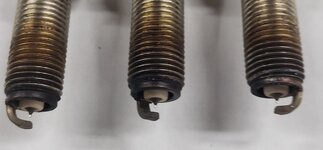 -
- 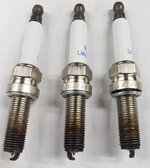
A little rich, maybe. But the cold start cycle will always be rich. Which is what these plugs would show, not running well enough to go more than a few minutes. Bottom line is they look to be in very good condition.
"These are 100k spark plugs in my car, Ron. So why does BRP say to change them at 28k?" This is one of the more common questions I get. Your car probably cruises at between 1,500 and 2,000 RPM most of the time. Whereas it's not uncommon to run at 4,000 RPM or higher on your Spyder. If you regularly run at lower RPM, you're likely doing long term harm to the motor. Especially if you're running with a V-Twin, 998.
With double and possibly triple the RPM in a high compression, high performance motor, a 28k service interval is not without merit.
It is commonly reported that when spark plugs are changed, they look, 'Good as new'. Which again prompts the question as to the necessity. But this is not surprising as the components you can see, contrary to older spark plug designs, resist wear quite well. Signs of age being masked by the technology used to produce a better product.
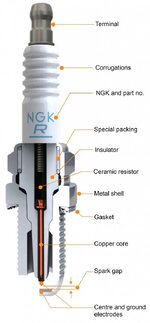
But, as shown in this anatomy of a Spark Plug picture, there are critical internal components which deteriorate with use. Again, well made and able to withstand long term use better than older designs, but without the ability to visually inspect. This deterioration can be slow and the customer may not notice the degradation in performance.
Granted, this Side-by-Side is on the Dire Case end of the spectrum. Frankly, both Daniel and I were surprised that spark plugs alone cured the problem. Especially after visual inspection.
So, is it necessary to change your plugs at 28k as recommended by BRP? Probably not. But neither is it always best to judge this book by its cover. There is a difference between peak service and an engine that starts and runs.
We changed the spark plugs and it now runs perfectly. That's all we did, a fresh set of 3, and it was off to the races.
So, why this post? Let's start by looking at the unaltered plugs we pulled.
- A little rich, maybe. But the cold start cycle will always be rich. Which is what these plugs would show, not running well enough to go more than a few minutes. Bottom line is they look to be in very good condition.
"These are 100k spark plugs in my car, Ron. So why does BRP say to change them at 28k?" This is one of the more common questions I get. Your car probably cruises at between 1,500 and 2,000 RPM most of the time. Whereas it's not uncommon to run at 4,000 RPM or higher on your Spyder. If you regularly run at lower RPM, you're likely doing long term harm to the motor. Especially if you're running with a V-Twin, 998.
With double and possibly triple the RPM in a high compression, high performance motor, a 28k service interval is not without merit.
It is commonly reported that when spark plugs are changed, they look, 'Good as new'. Which again prompts the question as to the necessity. But this is not surprising as the components you can see, contrary to older spark plug designs, resist wear quite well. Signs of age being masked by the technology used to produce a better product.
But, as shown in this anatomy of a Spark Plug picture, there are critical internal components which deteriorate with use. Again, well made and able to withstand long term use better than older designs, but without the ability to visually inspect. This deterioration can be slow and the customer may not notice the degradation in performance.
Granted, this Side-by-Side is on the Dire Case end of the spectrum. Frankly, both Daniel and I were surprised that spark plugs alone cured the problem. Especially after visual inspection.
So, is it necessary to change your plugs at 28k as recommended by BRP? Probably not. But neither is it always best to judge this book by its cover. There is a difference between peak service and an engine that starts and runs.


