• There were many reasons for the change of the site software, the biggest was security. The age of the old software also meant no server updates for certain programs. There are many benefits to the new software, one of the biggest is the mobile functionality. Ill fix up some stuff in the coming days, we'll also try to get some of the old addons back or the data imported back into the site like the garage. To create a thread or to reply with a post is basically the same as it was in the prior software. The default style of the site is light colored, but i temporarily added a darker colored style, to change you can find a link at the bottom of the site.

Blackstone Results for Amsoil 5W40 Metric Oil in my 2022 RT S2S

troop

Well-known member
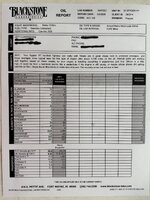
Just received my results back from my very first oil analysis. My buddy is a Amsoil dealer, so I thought I'd try some Amsoil 5w40 Metric Motorcycle oil in my machine. BRP does call for 5w40, and I am generally a 10w40 user. It states viscosity is low, unrelated to fuel. It basically sheared down to a 30w grade. It confirms my previous belief that a 10w40 oil might be a better choice. I actually replaced it with Castrol Power 1 10w50 full syn. I also wonder if the high silicon content may be from using a K&N filter? I do clean/re-oil the K&N every oil change, but wonder if it was fully seated? I know K&N's flow more air, but at the expense of smaller particles getting through. Just for the hell of it, I put my new OEM air filter back in.

e9f96ddc-5993-4404-963a-1ac0e15a4b25.jpg
 
We use Amsoil 10/40 exclusively. It typically shears down to between 36 & 38 at 10k. There is no reason to use a 5/40 in the Spyder unless you're storing it in sub-zero temperatures. The wider the spread between the low number and the high number, the more tendency for the oil to lose viscosity.

BRP's 5/40 typically shears down to 20 weight at 5,000 miles.
 
Lots of numbers but what does any of it mean to a mere human? I live in a temperate climate, rarely goes below 10 or above 95F. My RT struggles to turn over in the cold (un-heated shed) yet is crisp to start in warmer temps. Battery is fresh and tendered. In my uneducated mind I believe 5w-40/50 would reduce a wee bit of drag when oil is cold. Am I wrong?
 
The spread between the low number to the high number is a thing. I do a lot of cold weather riding and use the 10W-40 Amsoil. I just baby it until the temp gauge gets to operating temperature, then have at it. I would do the same with 5W-40. Troop may be over-servicing the K&N as a layer of dirt acts like a filter to trap the finer stuff. My last silicon number was 3 with a 9300 miles service interval. Maybe the locking ring on the air duct is not tight?
 
Last edited:
Apples to Apples, yes, a lower cold viscosity oil will allow the engine to spin easier in cold temperatures. However, a true synthetic oil like Amsoil, as opposed to virtually all other brands which use a type III base mineral oil and additive package, are not an apples to apples comparison. This is why misleading marketing placing both products in the same category is dishonest.

A true synthetic flows better in cold conditions at the same rated viscosity. Amsoil 10 weight oil is good down to zero degrees. It will give you as good or better friction reduction than a 5 weight oil using type III base at the same temperature.

jjc54 is correct about the K&N filter. Filtration efficiency actually increases as the filter collects impurities. Most Spyders can go at least 50,000 miles before a service is needed. The K&N will flow more air dirty than the stock paper air filter flows when new. So, airflow is not the same concern as with a paper filter.

Overcleaning can be detrimental.

The 2nd error I see with the K&N is over-oiling. The idea being that if a little oil is good, more is better. Don't do it! All that is needed is a light (but even) layer of oil. Be sure to cover the entire surface evenly. Then let it sit for a bit in warm conditions. Wipe of any extra oil that may have drained from the fabric. And you're good to go for another 50k!
 
Last edited:
Something else to keep in mind is the more viscosity improver that is used to create the wide spread in viscocity, the faster the oil will usually sheer. All other things being equal, 0W50 will sheer faster than a 20w50 for example. Use what oil viscosity your operating temps dictate and adjust the intervals as needed.

Amsoil MCF 10W40 was still in range and suitable for continued use at 9000+ miles in our RT that saw mostly higher speed highway miles.

We have been camping off the Canyon and have been caught twice with morning temps in the 20's. She starts fine with 10W40, but wonder if 5w40 could be a marginal improvement during the fall-spring riding season?
 
When you say better friction reduction do you mean flowability?
There is more than one source of friction. Flowability is one. Resistance between mated and moving components is another. Flowability affects the time between when the oil pump begins to turn and pressurized lubricant is delivered to remote components. Thinner fluids flow faster than thicker fluids.

Think about the difference in effort to suck a shake through a straw as opposed to doing the same with a Coke. This is an exaggeration when it comes to this subject, but you get the point.

Theoretically, mated spinning components will have more friction until pressurized oil reaches them. However, a true synthetic oil is proven to stay with parts better than a type III base lubricant. Which reduces startup friction.

There is also stiction, which is a combination of two words. Static and Friction. When there are two components touching each other, a specific force is required to get them to move. And a certain amount of force to keep them moving.

Increase stiction and you increase the amount of energy the starter has to produce. This can, and does, slow your crank speed.

A multi-viscosity oil is thicker at startup than it is at operating temperature. The low number and high number are relative viscosities based upon temperature of the lubricant. Not a direct comparison. Type III lubricants use an additive package to acheive the viscosity spread. True synthetics requre very little in the way of additives. Additives are not lubricants, they are modifiers. Additives are added to address the inherent instabilities of the base oil. True synthetics are Inherently stable and simply don't need much in the way of additives.

A thicker oil will create more friction between parts than a thinner oil. This is why many manufacturers recommend a 0/20 oil or other very thin oils. Less friction, better fuel mileage. But thinner oils may not, and usually don’t, protect mated parts as well. So, you’re trading a mile or 2 better fuel mileage for higher engine wear.

But the oil can be so thick that it also fails to protect mated parts. For example, a 50-weight oil is almost always too thick to efficiently protect friction parts. But the upper number is the viscosity rating measured at 212 degrees. Below this temperature, the viscosity is higher. Above this temperature, the viscosity is lower.

So, you can see where I am going with this. The oil in an air-cooled Harley, for example, can get much hotter than 212 degrees. Especially the oil that is unlucky enough to come into contact with the upper cylinder walls (which can reach and exceed 400 degrees). What happens to your 50-weight then? It can easily thin to 30-weight. But that’s exactly where it needs to be to protect those parts. In this situation, the engineers compensate with an overweighted oil to achieve the desired results.

In an air-cooled engine such as the Spyder, a 50-weight oil is rarely needed. Because nowhere in the engine are temperatures high enough to require it.

Always remember. Everything in this life is a trade-off.

Thinner flows better at startup, can improve cranking speed, delivers oil to remote parts more quickly, will give you better fuel mileage, and can increase engine cooling properties (as long as it is not so thin that friction is increased). But thinner also shears more readily. So, it starts thin and gets thinner. Too thin will not provide adequate separation between mated components which can increase friction and wear.

Thicker oil protects friction components better, preventing wear. But too thick can be detrimental to engine cooling, increase startup friction, and delay lubricant delivery to remote parts. Thicker will give a slight reduction in fuel mileage.

Oil is what I call a ‘Goldie Locks’ item. You don’t want it too thick, and you don’t want it too thin. You want it ‘Just Right’, if that is possible. Unfortunately, there is a lot of less than accurate information mixed into this realm. Including less than honest marketing. It is no wonder that people come away confused.

I've heard opinions that range from ‘All oil is the same, just get whatever you like and stick with it’, to ‘There is only 1 oil that does the job.’ Neither is true. Oils are definitely not all the same. You should put some thought into your choice of lubricant. And there are certainly more than one that will do a good job for you.

The last thing that I will say here, and I've said it before, is that BRP sells what they have. When the Spyder first came out, BRP had a specific lubricant for everything they made. And a 10/40 oil was recommended for the Spyder with a recommended 4,500 mile service interval. Today, there are only 2 lubricants for everything BRP makes.

Then you will say 'But Ron! But Ron! That was a 998 V-Twin! We are now running a completely different engine!' And I will say that you are exactly right. A very good point indeed! However. All the oil analysis that we've done shows that the 1330 treats the oil (viscosity wise) exactly like the previous V-Twin did. The oil begins to sheer drastically after about 4,500. Ending up at 20 weight at 5,000 miles on both machines. This suggests that the service interval for the original Spyders took this fact into account.

 
Last edited:
Using the same oil as you and have been changing at 10K with good analysis results. Think I'm going to try 12K next change and see what the analysis says.
If I were out of warranty, I would definitely extend the drain interval according to UOA.

I've gone over 70k miles on the Amsoil in my Peterbilt that was also equipped with a centrifuge filter with good results. You can actually watch the condition of your oil change more rapidly as the tuneup interval approaches on most vehicles from what I have seen over the years.
 
Just received my results back from my very first oil analysis. My buddy is a Amsoil dealer, so I thought I'd try some Amsoil 5w40 Metric Motorcycle oil in my machine. BRP does call for 5w40, and I am generally a 10w40 user. It states viscosity is low, unrelated to fuel. It basically sheared down to a 30w grade. It confirms my previous belief that a 10w40 oil might be a better choice. I actually replaced it with Castrol Power 1 10w50 full syn. I also wonder if the high silicon content may be from using a K&N filter? I do clean/re-oil the K&N every oil change, but wonder if it was fully seated? I know K&N's flow more air, but at the expense of smaller particles getting through. Just for the hell of it, I put my new OEM air filter back in.

View attachment 255255
I am using a K+N air and oil filter atm and running rotella 15-w40 and with my last test silicon was at 6. But some of my other numbers were a lot higher with Iron, Magnesium, Phosphorus, and Zinc.
 
Yeah ... Still under the BRP B.E.S.T. warranty. That said, the 5900 miles was done in a 11 month period, so I will continue to change it within a calendar year. Regarding the silicon, I'm going to go with the freshly cleaned filter theory. I do know that K&N's do filter out the smaller particles better with a bit of filtration layer, but the anal side of me wants to clean the dark circular area when I change the oil. I know I'm not over spraying it with oil. I bought the K&N a month after I bought my 2019 F3S, and transferred it onto the RT S2S when I got it home from the dealer. I am aware of the filter/cap lock orientation. If I get ambitious, I'll put the K&N back in, as my DJ PV4 tunes are built with that filter. Too hot today :)
 
There is more than one source of friction. Flowability is one. Resistance between mated and moving components is another. Flowability affects the time between when the oil pump begins to turn and pressurized lubricant is delivered to remote components. Thinner fluids flow faster than thicker fluids.

Think about the difference in effort to suck a shake through a straw as opposed to doing the same with a Coke. This is an exaggeration when it comes to this subject, but you get the point.

Theoretically, mated spinning components will have more friction until pressurized oil reaches them. However, a true synthetic oil is proven to stay with parts better than a type III base lubricant. Which reduces startup friction.

There is also stiction, which is a combination of two words. Static and Friction. When there are two components touching each other, a specific force is required to get them to move. And a certain amount of force to keep them moving.

Increase stiction and you increase the amount of energy the starter has to produce. This can, and does, slow your crank speed.

A multi-viscosity oil is thicker at startup than it is at operating temperature. The low number and high number are relative viscosities based upon temperature of the lubricant. Not a direct comparison. Type III lubricants use an additive package to acheive the viscosity spread. True synthetics requre very little in the way of additives. Additives are not lubricants, they are modifiers. Additives are added to address the inherent instabilities of the base oil. Inherently stable lubricants simply don't need it.

A thicker oil will create more friction between parts than a thinner oil. This is why many manufacturers recommend a 0/20 oil or other very thin oils. Less friction, better fuel mileage. But thinner oils may not, and usually don’t, protect mated parts as well. So, you’re trading a mile or 2 better fuel mileage for higher engine wear.

But the oil can be so thick that it also fails to protect mated parts. For example, a 50-weight oil is almost always too thick to efficiently protect friction parts. But the upper number is the viscosity rating measured at 212 degrees. Below this temperature, the viscosity is higher. Above this temperature, the viscosity is lower.

So, you can see where I am going with this. The oil in an air-cooled Harley, for example, can get much hotter than 212 degrees. Especially the oil that is unlucky enough to come into contact with the upper cylinder walls (which can reach and exceed 400 degrees). What happens to your 50-weight then? It can easily thin to 30-weight. But that’s exactly where it needs to be to protect those parts. In this situation, the engineers compensate with an overweighted oil to achieve the desired results.

In an air-cooled engine such as the Spyder, a 50-weight oil is rarely needed. Because nowhere in the engine are temperatures high enough to require it.

Always remember. Everything in this life is a trade-off.

Thinner flows better at startup, can improve cranking speed, delivers oil to remote parts more quickly, will give you better fuel mileage, and can increase engine cooling properties (as long as it is not so thin that friction is increased). But thinner also shears more readily. So, it starts thin and gets thinner. Too thin will not provide adequate separation between mated components which can increase friction and wear.

Thicker oil protects friction components better, preventing wear. But too thick can be detrimental to engine cooling, increase startup friction, and delay lubricant delivery to remote parts. Thicker will give a slight reduction in fuel mileage.

Oil is what I call a ‘Goldie Locks’ item. You don’t want it too thick, and you don’t want it too thin. You want it ‘Just Right’, if that is possible. Unfortunately, there is a lot of less than accurate information mixed into this realm. Including less than honest marketing. It is no wonder that people come away confused.

I've heard opinions that range from ‘All oil is the same, just get whatever you like and stick with it’, to ‘There is only 1 oil that does the job.’ Neither is true. Oils are definitely not all the same. You should put some thought into your choice of lubricant. And there are certainly more than one that will do a good job for you.

The last thing that I will say here, and I've said it before, is that BRP sells what they have. When the Spyder first came out, BRP had a specific lubricant for everything they made. And a 10/40 oil was recommended for the Spyder with a recommended 4,500 mile service interval. Today, there are only 2 lubricants for everything BRP makes.

Then you will say 'But Ron! But Ron! That was a 998 V-Twin! We are now running a completely different engine!' And I will say that you are exactly right. A very good point indeed! However. All the oil analysis that we've done shows that the 1330 treats the oil (viscosity wise) exactly like the previous V-Twin did. The oil begins to sheer drastically after about 4,500. Ending up at 20 weight at 5,000 miles on both machines. This suggests that the service interval for the original Spyders took this fact into account.
Perhaps the last paragraph suggests that the oil is sheered significantly by the transmission for which both bikes have a very similar design. I would have expected other readings in the oil analysis to vary though as the 998 twin revs consistently higher than the 1330 triple. I don't know if you observed this or not?
 
Perhaps the last paragraph suggests that the oil is sheered significantly by the transmission for which both bikes have a very similar design. I would have expected other readings in the oil analysis to vary though as the 998 twin revs consistently higher than the 1330 triple. I don't know if you observed this or not?
You are exactly right. It is the transmission that is the Oil Sheering Culprit in both machines. It is not really a surprise that the 1330 eats oil viscosity just like the V-Twin. Though the 1330 is much easier on the oil usage scale. A 998 will go through at least half to 3/4 quart in 4,500 miles. The 1330 uses virtually none at all in 10k.

On another note, I have to say this is one of the reasons I love this forum. Where else can you have a rational discussion about oil! People go sideways over the subject elsewhere. If someone disagrees, I am more than happy to hear their side. I’ve been wrong before. And I’m pretty sure it’s going to happen again.

It’s always a mix of facts, opinion, and speculation. We can enjoy the input without necessarily having to agree. I applaud the people here who seem to appreciate what we have.
 
Last edited:
Lots of numbers but what does any of it mean to a mere human? I live in a temperate climate, rarely goes below 10 or above 95F. My RT struggles to turn over in the cold (un-heated shed) yet is crisp to start in warmer temps. Battery is fresh and tendered. In my uneducated mind I believe 5w-40/50 would reduce a wee bit of drag when oil is cold. Am I wrong?

Given that @troop's OP tells us this is the very first oil analysis he's done on this Spyder, it's the 'Comments' section that are probably conveying the most valuable info at this time - all the rest of the number are really best treated as just a baseline reading at this stage. Sure, all those numbers are good to know, and they can provide an insight into the health of the engine internals to those in the know (ie. usually the people who wrote the comments, not too often the Spyder owner...) but for the majority of the Spyder Owning/Ryding community, especially those owners of 1330 powered Spyders, it's far more likely that it'll be the 'Trends in those numbers as they develop over time' that will be most revealing!

That's not saying you need to get an oil analysis done on every oil change, especially if you only change your Spyder's oil once a year or so cos that's what the manual says and you never reach the milage recommendation for an oil change in a year anyway - getting an oil analysis done that frequently is probably a bit of overkill & maybe a waste of money, simply because there probably isn't going to be very much change in any of the numbers if you haven't done much more than 5000 or so miles, and even then, any change will likely be fairly small, possibly just due to differences in the collection &/or testing processes, and any actual trends, rather than just minor differences in collection/testing/test conditions will be very difficult to detect! It probably won't hurt to analyse your oil that often per se, but it won't make life easier for anyone, nor is it really all that likely to save you from a catastrophic failure; well, maybe it won't hurt anything except your wallet and possibly your peace of mind, cos there will be minor collection/testing variances so they'll likely drive you &/or the analysists nuts trying to decipher and analyse the tiny variations revealed, variations that are so small they might just be inherent differences in the process...

It CAN be worthwhile doing more frequent analysis of the oil on vehicles that do a lot of milage/running each year, especially things like Heavy Haul trucks & Heavy Machinery, ie. things that work hard/hot and oil changes are difficult &/or expensive; and as others have suggested, the analysis results of the oil can be used to shorten/extend the oil change intervals, which may bring significant savings on those sorts of vehicles/under those conditions; but really, unless something that's pretty drastically wrong is revealed by the baseline analysis (ie. high 'wear metal' counts, massively high silicone/dust counts...) or you forget some fairly important maintenance item (like you completely forgot to put the air filter back in at all after your last service!) then you're probably not going to see too much in the way of significant changes in too many of the numbers in your oil analysis if you've done less than 5000 or so miles since the last analysis!

So for our relatively low milage/low load Spyders, it's the TRENDS in those numbers over time and miles that really tell the story; and there's likely no real point in getting an oil analysis done on every oil change, especially if you never meet the milage recommendation before changing the oil! You'd probably be better served by getting an analysis done on saaay, every third oil change, so that the resulting trends/changes are clearly evident and meaningful, rather than potentially just minor variations in the process. :rolleyes:

Just Sayin' ;)
 
Back
Top