Well, to be thorough, let's revisit the codes again just to be sure. Take the thing out a bit around the block to ensure that the fault codes, if any, are Active. Keep an eye out for that orange screen that says Brake Failure. Without BUDS, you can only read Active codes at that exact time that you are reading them. When you come back, leave the bike running,
don't turn off the key. Then push the three buttons, MODE, SET, and TURN SIGNAL straight in (cancel position)
all at the same time. The center LCD should change to a new screen away from the speedometer screen. Even if there are no codes, the screen still changes, but it is blank. You can even get creative if you want and check with the parking brake both engaged and disengaged. Let's double check the codes. If the screen doesn't change, then you have to refine your technique.
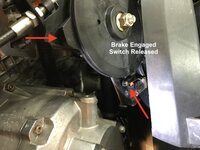
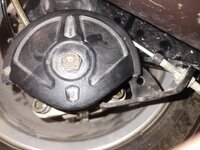
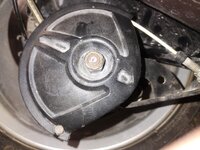
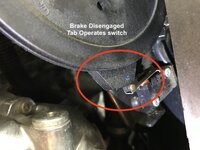
If we're certain of no codes, then it goes back to the micro-switch. Pull off the right side panels to find the front pulley at the other end of the parking brake cable. There's a micro-switch mounted towards the bottom. Operate the parking brake a couple of time to understand how it works. When you disengage the brake, the parking brake motor turns the front pulley CCW. That spring in the rear pulley turns the rear pulley CCW and pulls the cable back. The front pulley doesn't push the cable. The front pulley turns until the tab on it, starting around the 9 o-clock position or so, actuates the micro switch. That's when it stops turning. See Pics. Two things to check then. The condition of the micro-switch and the little actuating arm should be as shown and not all bent up. The micro-switch turns the light off in this position. The other thing to check is the cable. At the top of the front pulley, it should still be straight going into the cable holder. Even when disengaged, there needs to be slight spring pressure from the rear spring on the cable. Otherwise, if it bows up too much, it will come unhooked. Those two nuts on the rear caliper adjust the cable just like any other cable adjuster. If needed, then adjust them to take the slack out off the cable until the rear pulley just starts to turn and puts spring pressure on the cable. If necessary, you may need to remove the rear pulley and set it on a different spline on the shaft to get the correct adjustment.
When you engage the brake, the front pulley rotates CW, pulling the cable and setting the brake. The micro-switch is released. The motor turns the front pulley until the brake comes on and the motor stalls. Then the module de-energizes the motor. That tab on the opposite side of the front pulley, up near the top, should never contact the micro-switch. It's there to stop the motor should the cable become disconnected or break. The problem is that if that tab is all the way around to the switch, when the pulley turns the other direction, it catches the actuating arm of the switch and bends it all to heck. If yours is bent up, you can straighten it out and test operate the parking brake system once you ensure that the cable is properly adjusted. It doesn't hurt to get some lube on the micro-switch, like dry silicone.
While we all encourage DIY-ers here, you could really benefit from a shop manual. 25 bucks.
Professional Keyword Searchable Factory OEM Manual - 1169 Pages !! New updated full digital version as of 2022 !! It covers the 2012 Can-Am Spyder RT (Auto, Manual & LTD) Series Including the Spyder trailer. This manual contains hundreds of pages with extra content that the expensive book...

brpmanuals.com
-