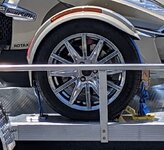
Albec
Well-known member
Washing in the sun? No shade available for ya?Wash day.
View attachment 255337

Washing in the sun? No shade available for ya?Wash day.
View attachment 255337

Nope. Gotta do what you gotta do ;-)>Washing in the sun? No shade available for ya?

 -
- 

HI mecsw500,Perhaps make sure you polish or brush off any corrosion that built up between the old rotor and the hub to get a nice clean mating surface. I found I had to take everything off and start again, as I failed to do that on a motorcycle I had in the past, and one of the disk's just didn't sit right or feel right. I was amazed at the corrosion that had built up between the disk and the rotor, I presume from electrostatic processes between differing metal types.
Well, this past weekend, I finally had a chance to install the new front brakes and rotor's.
The right side front brakes were the most difficult to change, due to removing the small retaining wire/pin and the bolt (I used a Torx T30) that holds the brake pad retention pin. Also, there is not much space to work in the area, and when I was putting it back together, the long pin that runs horizontally through the top of the caliper that secures the brake pads and the anti-rattle spring clip was difficult to put through the holes - it would not line up. I finally got the pin through the brake pads and the caliper. I did use Blue Loctite on the threads of the retaining pin. I also did the left side front pads and rotors. This side was much easier to do.
I checked the brake fluid reservoir and I did have to add any DOT 4 fluid to the reservoir.
I pumped the brakes 5 to 10 times. They worked. Then I took a short ride to set the brakes/rotors, but I did not do any hard braking. I let the Spyder glide then I applied the brakes slow and I came to a complete stop. I did not have any spongy brakes.
Mileage on the bike when I did the above was 8,811.6 miles.
I know that is low mileage, but life gets in the way.
After I changed the front brakes and rotors, I did not have any shaking on the left side of the bike.
The left side OEM rotor was warped.
Deanna

Well done you.Well, this past weekend, I finally had a chance to install the new front brakes and rotor's.
The right side front brakes were the most difficult to change, due to removing the small retaining wire/pin and the bolt (I used a Torx T30) that holds the brake pad retention pin. Also, there is not much space to work in the area, and when I was putting it back together, the long pin that runs horizontally through the top of the caliper that secures the brake pads and the anti-rattle spring clip was difficult to put through the holes - it would not line up. I finally got the pin through the brake pads and the caliper. I did use Blue Loctite on the threads of the retaining pin. I also did the left side front pads and rotors. This side was much easier to do.
I checked the brake fluid reservoir and I did have to add any DOT 4 fluid to the reservoir.
I pumped the brakes 5 to 10 times. They worked. Then I took a short ride to set the brakes/rotors, but I did not do any hard braking. I let the Spyder glide then I applied the brakes slow and I came to a complete stop. I did not have any spongy brakes.
Mileage on the bike when I did the above was 8,811.6 miles.
I know that is low mileage, but life gets in the way.
After I changed the front brakes and rotors, I did not have any shaking on the left side of the bike.
The left side OEM rotor was warped.
Deanna
Thanks!Well done you.
Tell us again, were these OEM or third party rotors and pads?
If third party, which brand did you use?
HI Albec,Since I don't know, I'm asking.
Is it necessary to bed in the new brake pads?

Very good description of the brake bedding procedure.Thanks!
They were the third party rotors and pads.
I used EBC brakes/rotors. Also, when the time comes, I'll be getting new tires all around, and at that time I will have a Can Am dealership install the rear EBC brake/rotor, when they install the tire on the rear.
HI Albec,
Yes, it is. The process lays down an even layer of pad material on the rotors, ensuring maximum stopping power, preventing brake fade, and reducing squeaking. Before you do anything else, make sure you pump the brake pedal several times while the Spyder is stationary. Changing pads pushes the pistons back, creating a gap. Pumping the pedal closes that gap so that your brakes have pressure on your very first ride.
Warm them up, by accelerating to about 35 mph and then apply moderate, steady brake pressure to slow the Spyder down to about 5 mph.
Repeat, doing the above 5 to 10 times in quick succession to heat up the brakes.
Aggressive stops (optional but helpful) do 2 to 3 harder stops from about 45 mph down to 5 mph.
Cooling down, ride for about 5-10 miles without using your brakes to let the rotors cool completely. Coasting allows the heat to escape naturally.
Deanna

Now all I have to do is figure out how to get the front 24" into the air to get the old one out.
Very good description of the brake bedding procedure.
The first few heat cycles will impact the performance of those pads for their entire life.
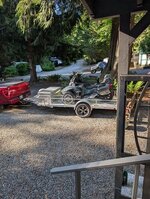

Trike is loaded on trailer for trip the dealer an hour away.
View attachment 255395

 Just Sayin' (and maybe yanking the chain a little, too. After all, it was just hanging there asking... no, pleading to be yanked.
  )
)
Spyders get tied down on all three wheel/tires with Erickson E-track stuff.Nice looking trailer/tow package, and the Spyder does look pretty good up there, but I gotta say that the 'non-matching rims' on the trailer do mess with the view just a little!