• There were many reasons for the change of the site software, the biggest was security. The age of the old software also meant no server updates for certain programs. There are many benefits to the new software, one of the biggest is the mobile functionality. Ill fix up some stuff in the coming days, we'll also try to get some of the old addons back or the data imported back into the site like the garage. To create a thread or to reply with a post is basically the same as it was in the prior software. The default style of the site is light colored, but i temporarily added a darker colored style, to change you can find a link at the bottom of the site.

Intermittent raw gas smell at start-up and goes away after a few minutes - Any thoughts on what to check next?

jjc54

Active member
I did an oil change with fuel filter change on Aug 4th. On Sep 8th, after 22 rides after service and 1,425 miles, I got a very distinct raw fuel smell that persisted for a minute or 2 into the ride. After the ride, I pulled the plastic and checked for leaks with the fuel pump energized. Everything was dry with no evidence of there ever being a drip. Happened again after another 10 rides and another 1,350 miles. Once again, I pulled the plastic and found nothing. The Bike is running great with no drop-off in MPG. Any thoughts on what to check next?

Checked out the parts diagram and there is a bleed valve (?) and a rollover valve that looks like I need to remove more plastic to get to. The diagram also showed several more hoses, but I could not tell where they would hook up to. The bike has been a jewel up to now, but I don't relish becoming a human torch! Both times it was on the cooler side and less than 1/2 a tank of gas.
 
Last edited:
It would help to know what Spyder you have.
I had a 2013 RTL that all of a sudden lost power, got hot at my right foot, I parked it to load back on the trailer, only it burned up!
 
Regardless of year or model, the smell of raw gasoline needs to be addressed ASAP. While the 1330 is less susceptible compared to the 998 V-Twin, you still run the very real risk of burning your Spyder to the ground in a big hurry. The Tupperware captures those gasoline vapors within the very hot engine compartment. The perfect environment for ignition. It only takes one small spark and its all over but the getting off and moving away to watch helplessly.

It is commendable that you have attempted to find the source. But without positive resolution, you are exposing yourself and your ride to a very serious possibility.

With the hot environment under the Tupperware, a fine spray of fuel, especially under high pressure, will dry very quickly. Though it may be difficult to find, it is imperative that you do. I wish you a quick solution. It’s probably something very minor.
 
Regardless of year or model, the smell of raw gasoline needs to be addressed ASAP. While the 1330 is less susceptible compared to the 998 V-Twin, you still run the very real risk of burning your Spyder to the ground in a big hurry. The Tupperware captures those gasoline vapors within the very hot engine compartment. The perfect environment for ignition. It only takes one small spark and its all over but the getting off and moving away to watch helplessly.

It is commendable that you have attempted to find the source. But without positive resolution, you are exposing yourself and your ride to a very serious possibility.

With the hot environment under the Tupperware, a fine spray of fuel, especially under high pressure, will dry very quickly. Though it may be difficult to find, it is imperative that you do. I wish you a quick solution. It’s probably something very minor.

Agree, & the OP does not mention any troubles with the fuel cap (this was a known problem on some years - I don’t know what the OP has?)
 
Anybody know what the function of the bleed valve is? PN 709000443.

Yes. That's BRP's name for the purge valve in the evap system. Train yourself up on system operation if necessary, I'm not going to take up the space here. The valve is normally closed at startup and until you reach highway speed. So, if it is intermittently sticking closed on you, that would not cause your issue because it is normally closed at the beginning of a ride, anyway. If it is intermittently sticking open, that would cause all of the fuel fumes to be sucked into the engine as soon as it was started, as well as a hard starting issue. So, that wouldn't cause your fuel smell, either.

When you turn on the key - with the Kill Switch in RUN - the fuel pump only runs for 3 seconds. So, your statement about checking for leaks with the fuel pump energized is probably not valid. Three seconds isn't long enough to find a slow, intermittent leak, or a fine spray. You'll need to run the engine and allow the fuel system to reach rated pressure - about 75# - or an extended period of time to get a good leak check.

The roll-over valve is integrated into the tank vent, and is exactly what the name implies. It has nothing to do with your issue because you are not rolled over.

After all of these miles and all of these years, you could have simply reached the end of useful life on your charcoal canister and it is time for replacement. As B said, check the large O-ring in your gas cap. And evaluate if the gas smell might coincide with topping off your tank.
 
Yes. That's BRP's name for the purge valve in the evap system. Train yourself up on system operation if necessary, I'm not going to take up the space here. The valve is normally closed at startup and until you reach highway speed. So, if it is intermittently sticking closed on you, that would not cause your issue because it is normally closed at the beginning of a ride, anyway. If it is intermittently sticking open, that would cause all of the fuel fumes to be sucked into the engine as soon as it was started, as well as a hard starting issue. So, that wouldn't cause your fuel smell, either.

When you turn on the key - with the Kill Switch in RUN - the fuel pump only runs for 3 seconds. So, your statement about checking for leaks with the fuel pump energized is probably not valid. Three seconds isn't long enough to find a slow, intermittent leak, or a fine spray. You'll need to run the engine and allow the fuel system to reach rated pressure - about 75# - or an extended period of time to get a good leak check.

The roll-over valve is integrated into the tank vent, and is exactly what the name implies. It has nothing to do with your issue because you are not rolled over.

After all of these miles and all of these years, you could have simply reached the end of useful life on your charcoal canister and it is time for replacement. As B said, check the large O-ring in your gas cap. And evaluate if the gas smell might coincide with topping off your tank.

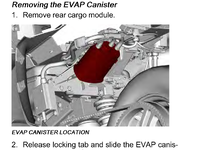
The 2 times it happened the tank was well under 1/2. The manual shows to replace the canister the whole back end needs to be removed. Is this the case? What are the consequences of operating with a worn out canister. Can this wait until down time? Any way to check the function of this canister?
 
Any vehicle with an evap system (charcoal canister) has a non-venting gas cap. Or at least, non-venting from the inside out. If it was vented, that would bypass and defeat the whole purpose of having the evap system in the first place. The Spyder gas cap recall was for caps that had an O-ring seal problem that allowed for venting/leakage from the inside out, thus bypassing the system and causing the smell and a hazardous condition. That’s why you were advised to check the O-ring inside your cap. Just turn it over and inspect it.
 
The 2 times it happened the tank was well under 1/2. The manual shows to replace the canister the whole back end needs to be removed. Is this the case? What are the consequences of operating with a worn out canister. Can this wait until down time? Any way to check the function of this canister?
So, to reset the table a bit - understandably you're sensitive to this after doing that maintenance. But, this could have been nothing more than the gas smell coming from a vehicle passing in the opposite direction.

However, not knowing what you already know, my intention was to make sure you understood the fuel pump operation. If you want to check for leaks for a few minutes, you either need the motor running the entire time or jumper an external source of power to it. Just having the key on is not enough. First time doing this? After market filter or OEM? If after market, verify the filter is rated for that pressure. Otherwise, they leak at the seam where the can is put together. Not all metal fuel filters are created equal. Also, it could be leaking slowly at your hose connections to the filter. Takes awhile to show up. Screw clamps or Oetiker clamps?

Your main priority now is to ensure there are no leaks in the fuel system. That's the hazard. If not, the canister is just one other possibility at this point. And even though the charcoal may not be 100% efficient anymore, it's not a safety concern, just an emissions thing. People usually don't change a canister until it causes a drivability issue with combustion related codes. If you really wanted to change something, you might consider the canister pre-filter. Also probably overdue after 10 years and 83k miles. Almost equally a pain to do, though. Your fuel system breathes through that, and then through the canister.
 
I don't want to high jack this post, but I have a question about the fuel system on the 1330! I know we had a problem with our 998 with trying to top of our tank and filling the canisters to the point of it running out on the ground. Now with the 1330 they still have the cans, and we have the crappie fill ports that hang down below the top of the tank, and you have to trickle the gas, so you don't spill it out trying to get the tank somewhat filled below the darn baffle in the filler neck!!! My question I guess is, should we be doing the cananatomy to our 1330's like we did to our 998?
 
There’s a couple of reasons why the evap system for the 1330 doesn’t cause any run-ability issues. The biggest one would be location. A canisterectomy on the 1330 is not necessary.

IMG_0606.png
 
So, to reset the table a bit - understandably you're sensitive to this after doing that maintenance. But, this could have been nothing more than the gas smell coming from a vehicle passing in the opposite direction.

However, not knowing what you already know, my intention was to make sure you understood the fuel pump operation. If you want to check for leaks for a few minutes, you either need the motor running the entire time or jumper an external source of power to it. Just having the key on is not enough. First time doing this? After market filter or OEM? If after market, verify the filter is rated for that pressure. Otherwise, they leak at the seam where the can is put together. Not all metal fuel filters are created equal. Also, it could be leaking slowly at your hose connections to the filter. Takes awhile to show up. Screw clamps or Oetiker clamps?

Your main priority now is to ensure there are no leaks in the fuel system. That's the hazard. If not, the canister is just one other possibility at this point. And even though the charcoal may not be 100% efficient anymore, it's not a safety concern, just an emissions thing. People usually don't change a canister until it causes a drivability issue with combustion related codes. If you really wanted to change something, you might consider the canister pre-filter. Also probably overdue after 10 years and 83k miles. Almost equally a pain to do, though. Your fuel system breathes through that, and then through the canister.
I will address this with my own 3 paragraphs.

The gas smell has only been detected 2 times. Each time it was right after start-up in my garage and only the vehicles that would have passed by would have been vehicles parked along the street in our extremely small subdivision on my way to the highway. Maybe somebody else has a vehicle parked in front of their house that needs attention?

The last time I checked for leaks, I did start it up and checked the connections for wetness. Didn't let it run too long as I was in the garage and got gassed out. Next time I will try in the driveway. This was the 3rd filter I have replaced. I got them all from NAPA and all 3 were Wix #3095. I replaced the screw type clamps I used last time with very expensive solid clamps that are tightened with a bolt. Made for high pressure fuel systems. I do still have one screw clamp as I replaced the very short hose the time before because it showed some cracking.

I have taken the pre-filter apart 3 times now and washed and replaced. It was serviced the same time the fuel filter was done. It was always very dirty each time.

I plan on taking it apart again and checking the hoses to and from the canister and another longer drip test.

Thank you for your time!
 
Back
Top