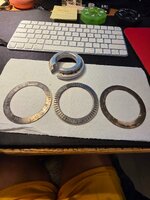
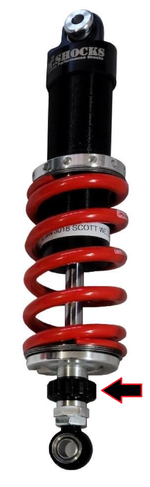
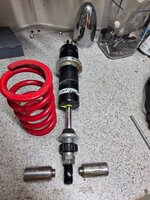
At first look, my eye is drawn the load being placed in the center of the bolt/shock eye with that 2pc spacer setup, but it's not like the net is littered with broken shock bolt reports? You might consider boring the spacers to the ID of the shock eye, drilling out your mounting bracket on the bike, and installing a larger bolt. Are the bushings damaged/worn in a manner where they can't pinch properly?
OE bolt diameter is 10mm, yes? What is the shock eye bore? The suggestion to swap out a grade 8 bolt would be a bad idea in this application. It would likely break instead of bend, leaving you on the side of the road.
Are you actually bottoming or this an assumption because of the bolt bending?
Another consideration, but I doubt this is your issue... The damping during high shaft speed moments (Example: hitting a square edged pothole at 65mph) is so high that the shaft could be effectively locked up. Without putting the shock on a dyno to test, you wouldn't know. Even though Marcus may have been considered a poor business man in my opinion, I believe he is very knowledgeable, having being in the business for some time. That said... he was selling a new "never set up" CTW shock dyno on ebay at the end, so was that a second dyno, or was he sending this stuff out unverified? Now I don't currently own a dyno, but I do own the vehicles that I send out tuned shocks for, and I have 60K miles of seat time. Marcus did not ride a Spyder?
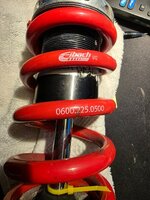
I wouldn't screw with the spring rate for now. I think 500# is near your sweet spot.
What is the stroke on that shock? Slide up the foam bumper and measure between the seal head and the flat under the bumper. Also, stroke the shock by hand. Are there any air bubbles, dead spots, or binding? Or is it smooth and restrictive in a linear fashion?
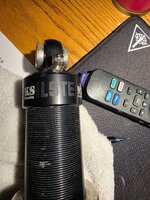
That adjuster knob is a "Bi-Directional" bleed. It's just a controlled leak around the piston, so it affects both compression and rebound at the same time, assuming yours is the same as what Marcus was going to sell me. Some shocks have a one way check valve where the bleed only flows in one direction too. Marcus told me it was bi-directional.
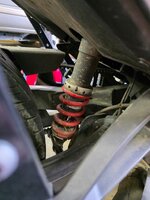
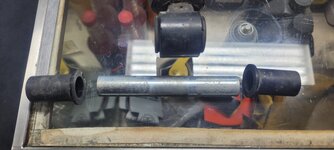
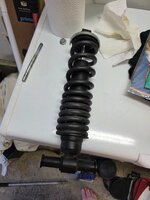
So I'll attach a pic of my RT's OEM mounting... It's honestly pretty ghetto! The Canyon Red Rock is much worse because it has play in it even though the shock is of WAY higher quality. I have yet to tear it down to see what can be done to improve it.
Note the 1pc tube that carries all of the load, spacers keep it centered, and the bolts only job is to clamp it within the lower mount!? With your current setup, he created a bending point in the center where the bushings meet, since there's not much meat to clamp there.


 -
-