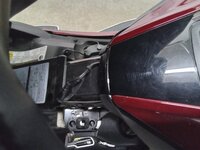
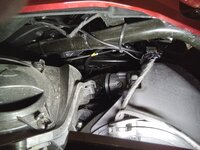
Heated jackets : this is my set-up.
My wiring includes provision for a few things - Heated Jackets, Satnav, On board Video.
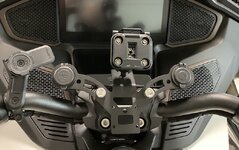
The Satnav is located on the dash behind the screen and comes on with ignition.
The video camera is An Innovv K7 setup. I'm not entirely happy with the location of the main unit (DVR), but it will do for now.
The Heated jacket sockets are provided for rider and for pillion.
I'll restrict this little essay to the Heated Jackets.
Images are shown as thumbnails - click them to see a larger version.
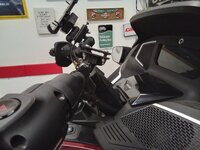
Front Socket
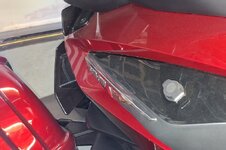
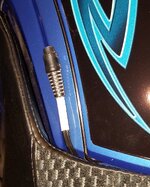
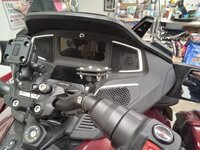
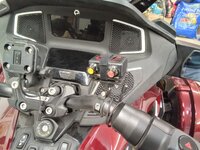
The rider has a front socket on the left hand side. as shown in the picture. Lef side is important as there is no off switch for the power. The jackets have a controller though and heat is pretty well regulated.
Jackets are a slim fit - no wires, just a membrane - manufactured by Keiss.
They provide battery use as well and these will last a considerable amount of time. I carry the batteries with me, but tend to use the wired jacket. I like the security of having a fully charged battery for if we are ever stuck at the side of the road waiting for recovery !
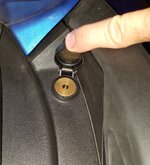
The previous owner had fitted a larger (cigarette lighter) socket in the front wing of the saddle on the lefthand side. The hole was too large for my sockets which are DIN / BMW / Powerlet capable of supplying up to 20A, and are designed so that the plug and socket never loose contact with each other - unlike cigaratte lighter sockets. IN any case - I have long legs and the socket would have bashed agains the inside of my knee. It is still there, but remains unconnected.
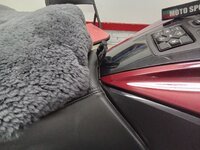
Rear Socket
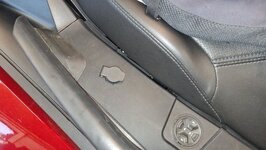
The rear socket is on the right hand side under the handrail. There is plenty of room under than panel for the socket and for the connector which attaches to the terminals under the socket. Plenty of room for access, and for the cable which comes up through the gap between seat and handle.
Power
I have taken a pair of 30A cables direct from the battery. The Red wire is fused and secured close the the battery and the cable is double insulated and runs in a protective sleeve. This has a simple 2 pin inline connector close to the battery so all of my accessories can be disabled in one go. The connector also serves as a connection for battery charger, and for the portable tyre pump.
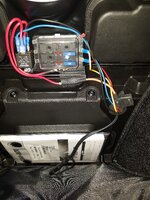
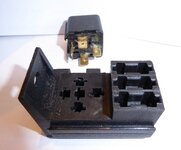
The red wire goes direct to a 40A relay which is located just ahead of the brake fluid reservoir supported with cable ties and a metal plate. The relay holder has 3 positions for fuses and these are wired to provide separate fused circuits for Heated jackets, the satnav and the camera.
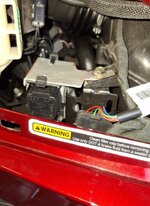
The fuse and relay holder looks like the photo, above, left. It is difficult to make out in the photo below it, but the back mounting plate on the relay/fuse base is secured to the metal plate and the top of the relay is facing the camera. The fuses are also facing the camera under the relay - so they cannot be seen in this shot.
The relay is triggered by an accessory plug that is provided just ahead of the Brake Fluid reservoir. It is plugged into a blank socket. I bought some male and female connectors and terminals (MX1900) and just wired it up (after a couple of practice attempts) to the earth and power for the relay coil. So everything turns off when the accessory circuits power down - about 10 seconds after ignition is turned off.
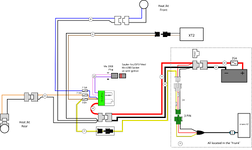
For convenience reasons I mounted the DVR camera recorder on a piece of shaped foam flooring and it slips inside a mesh pocket in the frunk. But there are now two many wires in there. And it gets very hot. I really need a place under the seat, and I think I have found a location that would work better. I need to check that out to make sure the DVR unit does not get any weight on it. If it works, the logic of the diagram below will remain the same, but the position of the Innovv K7 will change to near the left hand side of the diagram.
The camera needs to have a permanent battery feed as well as an on-with-ignition feed. That is because when the ignition is turned off, it needs time to save the current recording to the memory card - and that can take 20 seconds or so. I have had a battery go flat on me on my previous bike - and I suspect it was because I started the bike up, moved it uphill a couple of yards and then turned it off. The camera was still starting up, so when I cut the power, it didn't recognise the fact. And it kept running and the battery went flat. Now if I am away or leave the bike unattended at home - I disconnect the power connector in the frunk.
Cable Routing
There is plenty of space and routes under the plastic to run cables. I used polyester type expandable sleeve to run cables, and in some places added extra protection with spiral plastic sleeve. Where possible cable harnesses are secured to parts of the frame so that they cannot flap around.
I need a circuit diaagram to record all of this before I make up the harness. I can think it through before I set crimp tools to wires and connectors. And it is then a useful record.
Added here for entertainment purposes



www.lamonstergarage.com
 www.slingmods.com