
BajaRon
Well-known member
We get inquiries about exactly what the advantages and disadvantages of the two basic trike configurations are. Not to bash anyone's ride. Especially the Goldwing and Harley versions, as I know there is a large fan base with many who love them.
But I can assure you that physics has no dog in this race. It has no brand loyalty or preference. It doesn't get emotional or care when you are approaching a sharp blind turn or someone pulls out infront of you.
Nor will I attempt to cover all the variables from from power plant to electronics and accessories. Acknowledging there is much more to your ride than the platform. However, the platform is where most people start, and for good reasons. If the platform is wrong, all the bells and whistles in the world are not going to fix it for you.
Physics, in this case, determines, among other things, overall vehicle stability and handling. Suspension components and rider skills can extend the capabilities of any vehicle. But apples to apples, there can be no debate. The reverse trike has some unbeatable advantages.
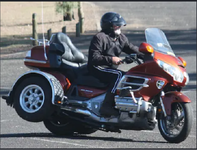
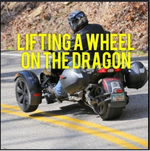
Everyone should know by now that you can lift the wheel on either design, though there is a definite difference between lifting a straight axle (conventional) and an independent suspension setup (Reverse). An unexpected wheel lift on the latter is generally less abrupt, more controllable, and less serious. Of course, if you never ride in such a way as to lift a wheel, this aspect may not matter to you. However, riders forced to perform an evasive manuver will appreciate the difference.
Both designs are pretty good at straight ahead handling. Neither are likely to give the rider any issues when all is going well and there are no additional requirements placed on the vehicle. But add some variables, and the differences become apparent.
In a turn, the major force is at an angle to the turn. Newton's First Law of Motion (Inertial Force) makes everything want to continue in a straight line. But you want to modify that (going around a corner, etc.) So, you turn the handlebars which turns the wheel(s) depending on what you are riding. Now you are asking your ride to defy Newton's law, which is doable, but there are some inescapable demands. In the end, it is physics that decides who gets their way.
In our case, this is based largely on 2 factors. Both having to do with the vehicle's ability to effectively and safely resist Mr. Newton's law.
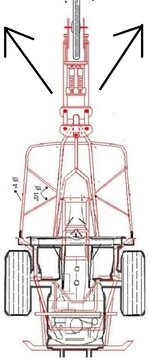
First is the platform design. As you can see in the diagram's below, the reverse platform trike has a great advantage here. It is the difference between someone trying to push you to the side while standing on 1 leg or 2. (And no, you don't get to hop!) It's no contest. Add some braking during your turn and the reverse trike advantage increases exponentially.
The conventional trike's rear wheels do help to resist this sideways pressure. But they are at a great disadvantage being placed at the back of the vehicle and away from ideal positioning. The Reverse Trike's front wheels act as outriggers, they offer stability that the conventional trike cannot.
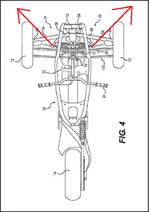
The next issue has to do with what is called the 'Contact Patch'. Which is the amount of rubber that is in contact with the road surface. Since it is the front tire(s) which are given the task of challenging Newton's Law. The amount of footprint makes a good bit of difference in how successful the change of direction will be. The greater the demand, the more important this factor is.
The typical conventional trike has a contact patch of around 4-5 square inches. A single Can-Am Spyder front tire has about 18 square inches in contact with the pavement, and there are 2 of them. 36 square inches compared to 5 square inches is huge in the battle with the laws of physics in a turn. Even if you do end up lifting a wheel, you still have over 3 times the contact patch of a conventional trike.
It all adds up to an end result. But no matter what you ride, know its limitations, and yours. It's all about the ryde!
But I can assure you that physics has no dog in this race. It has no brand loyalty or preference. It doesn't get emotional or care when you are approaching a sharp blind turn or someone pulls out infront of you.
Nor will I attempt to cover all the variables from from power plant to electronics and accessories. Acknowledging there is much more to your ride than the platform. However, the platform is where most people start, and for good reasons. If the platform is wrong, all the bells and whistles in the world are not going to fix it for you.
Physics, in this case, determines, among other things, overall vehicle stability and handling. Suspension components and rider skills can extend the capabilities of any vehicle. But apples to apples, there can be no debate. The reverse trike has some unbeatable advantages.
Everyone should know by now that you can lift the wheel on either design, though there is a definite difference between lifting a straight axle (conventional) and an independent suspension setup (Reverse). An unexpected wheel lift on the latter is generally less abrupt, more controllable, and less serious. Of course, if you never ride in such a way as to lift a wheel, this aspect may not matter to you. However, riders forced to perform an evasive manuver will appreciate the difference.
Both designs are pretty good at straight ahead handling. Neither are likely to give the rider any issues when all is going well and there are no additional requirements placed on the vehicle. But add some variables, and the differences become apparent.
In a turn, the major force is at an angle to the turn. Newton's First Law of Motion (Inertial Force) makes everything want to continue in a straight line. But you want to modify that (going around a corner, etc.) So, you turn the handlebars which turns the wheel(s) depending on what you are riding. Now you are asking your ride to defy Newton's law, which is doable, but there are some inescapable demands. In the end, it is physics that decides who gets their way.
In our case, this is based largely on 2 factors. Both having to do with the vehicle's ability to effectively and safely resist Mr. Newton's law.
First is the platform design. As you can see in the diagram's below, the reverse platform trike has a great advantage here. It is the difference between someone trying to push you to the side while standing on 1 leg or 2. (And no, you don't get to hop!) It's no contest. Add some braking during your turn and the reverse trike advantage increases exponentially.
The conventional trike's rear wheels do help to resist this sideways pressure. But they are at a great disadvantage being placed at the back of the vehicle and away from ideal positioning. The Reverse Trike's front wheels act as outriggers, they offer stability that the conventional trike cannot.
The next issue has to do with what is called the 'Contact Patch'. Which is the amount of rubber that is in contact with the road surface. Since it is the front tire(s) which are given the task of challenging Newton's Law. The amount of footprint makes a good bit of difference in how successful the change of direction will be. The greater the demand, the more important this factor is.
The typical conventional trike has a contact patch of around 4-5 square inches. A single Can-Am Spyder front tire has about 18 square inches in contact with the pavement, and there are 2 of them. 36 square inches compared to 5 square inches is huge in the battle with the laws of physics in a turn. Even if you do end up lifting a wheel, you still have over 3 times the contact patch of a conventional trike.
It all adds up to an end result. But no matter what you ride, know its limitations, and yours. It's all about the ryde!
Last edited: